


For most homeowners in Western Pennsylvania, Western New York, and Eastern Ohio, the foundation is “out of sight, out of mind.” We walk across our floors and sleep under our roofs assuming the ground beneath us is a static, unchanging anchor. However, our regional geology—defined by heavy clay, aggressive freeze-thaw cycles, and significant annual precipitation—is anything but static.
Foundation failure rarely happens overnight, but it does reach a “tipping point” where what was once a minor settling issue becomes a structural emergency. At Highlander Waterproofing & Foundation Repair, we’ve seen homes that were weeks away from catastrophic collapse. Knowing the difference between a cosmetic blemish and a structural emergency can save your home and, more importantly, your family’s safety. This guide outlines the five critical “red alerts” that require immediate professional intervention.
The Difference Between “Settling” and “Failing”
Every home undergoes some degree of settling, especially in the first few years after construction. As the weight of the structure compresses the soil, minor hairline cracks (less than 1/16th of an inch) may appear. This is typically “uniform settlement” and is rarely an emergency.
Foundation failure, however, is caused by differential settlement or extreme hydrostatic pressure. This is when parts of the foundation move at different speeds or in different directions. When the stress on the concrete exceeds its engineered load capacity, the structure begins to fail. In our region, the high water table and expanding clay make homes particularly susceptible to these rapid shifts.

Danger Sign #1: Sudden, Large Horizontal Cracks
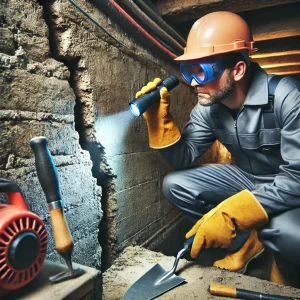
If you find a crack running horizontally along your basement wall, your home is in a state of high-stress structural failure. Unlike vertical cracks, which often indicate minor settlement, horizontal cracks are a direct result of hydrostatic pressure.
When the clay soil outside your home becomes saturated, it expands and exerts thousands of pounds of pressure against your basement walls. A horizontal crack usually appears mid-way up the wall or at the frost line. This indicates that the wall is physically being pushed inward. If you can fit a coin—or worse, a finger—into this crack, the wall’s structural integrity is compromised and it is at risk of a “blowout” or collapse.
Danger Sign #2: Doors or Windows That Won’t Close Overnight
We often blame “sticky” doors on humidity or old age. However, if multiple doors or windows in your home suddenly become difficult to open or close—especially if they were fine just a few weeks ago—it is a sign that the framing of your house is twisting.
As one side of your foundation sinks or shifts (differential settlement), it pulls the wooden “skeleton” of your home out of square. This creates “racking” in the door and window frames. If you notice a diagonal crack starting from the corner of a door frame and heading toward the ceiling, this is a “stress fracture” caused by the foundation dropping beneath it. This is a clear emergency sign that the footer is no longer supporting the load of the house.
Danger Sign #3: Significant Inward Bowing or “Shearing”
Sometimes you don’t even need to see a crack to know there is an emergency. If you stand at one end of your basement wall and look down the length of it, the wall should be perfectly straight. If you notice a “bulge” or a curve in the center, the wall is bowing.
An even more dangerous version of this is shearing. This occurs when the bottom of the wall is pushed inward while the base of the wall stays fixed to the footer. You will see the bottom row of blocks “sliding” across the floor. This means the connection between your home and its base has been severed. This requires immediate stabilization using steel I-beams or carbon fiber reinforcement to prevent the wall from kicking in entirely.
Danger Sign #4: The Tilting or Separating Chimney
Because chimneys are incredibly heavy and often built on a separate footer than the rest of the house, they act as an early warning system for soil failure. If you go outside and notice a gap between your brick chimney and the siding of your house, the chimney’s foundation is failing.
This is often an emergency because as the chimney tilts, it can pull on the rest of the home’s structure, causing roof leaks or even a total collapse of the masonry stack. A tilting chimney is a sign that the deep soil strata are unable to support the concentrated weight of your home’s heaviest components.
Danger Sign #5: Sudden “Stair-Step” Cracks in Exterior Brick
For homes with brick or stone veneers, the mortar lines provide a visual map of foundation movement. A “stair-step” crack is a diagonal line of cracks that follows the joints of the brick.
When these cracks appear suddenly and are wider at the top than the bottom, it indicates that the foundation corner is “dropping.” This is a sign of foundation heave or settlement failure. In Erie or Buffalo, this is often triggered by extreme winter temperatures causing “frost heave” that lifts and then drops the corner of the house, shattering the brittle masonry above.
Immediate Action Steps for Homeowners
If you identify one or more of these signs, do not panic, but do not wait. Foundation issues are progressive; they never “heal” on their own, and the cost of repair increases every month the problem is ignored.
- Step 1: Document the damage. Take clear photos of the cracks or bowing. Use a ruler in the photo to show the width of the gap.
- Step 2: Check for safety hazards. If you see gas lines or electrical conduits pulling away from the wall near a crack, call a professional immediately.
- Step 3: Call a Structural Specialist. General contractors often lack the specialized hydraulic equipment and engineering knowledge required for foundation stabilization. You need a specialist like Highlander who can perform piering or structural reinforcement.
Frequently Asked Questions
Q: Is a horizontal crack always an emergency?
A: In the context of a foundation, yes. Horizontal cracks represent a failure in the wall’s ability to resist outside pressure. Unlike vertical settlement cracks, they indicate a high risk of the wall moving inward or collapsing.
Q: Can I stay in my house if the foundation is failing?
A: In most cases, yes, as long as the failure is addressed promptly. Our team can install temporary shoring and permanent stabilization while you remain in the home. However, if the “shear” is extreme, we will advise on the immediate safety of the structure.
Q: How fast can a foundation fail?
A: While foundation issues often develop over years, they can escalate into a “failed” state in a matter of days during a catastrophic weather event, such as a rapid spring thaw or a week of heavy regional rain.
Your home is likely your most valuable asset, and its foundation is the only thing standing between that asset and the unpredictable earth. In Western PA and NY, our homes are constantly under pressure from the elements. While “old house quirks” are normal, horizontal cracks, sticking doors, and bowing walls are not—they are urgent cries for help from your home’s structure.
At Highlander Waterproofing & Foundation Repair, we specialize in high-stakes structural emergencies. We don’t just “patch” problems; we use science-backed engineering to restore your home’s integrity. Whether it’s through helical piering to stabilize a sinking corner or carbon fiber straps to lock a bowing wall in place, we provide permanent solutions backed by a lifetime transferable warranty. If you see the signs, don’t wait for the collapse—get the expert help you need today.
Think You Have a Foundation Emergency?
Don’t leave your family’s safety to chance. Our BBB Torch Award-winning team offers priority structural evaluations for homeowners facing emergency foundation signs. We’ll give you a clear, honest assessment and a path to a permanent fix.
Call Highlander’s Priority Line today or visit our contact page for an immediate structural evaluation!

Giulio and Jennifer Bevilacqua are the dedicated and passionate owners of Highlander Waterproofing, a trusted name in basement waterproofing and foundation repair. With a commitment to protecting homes and ensuring the safety and well-being of families, Giulio and Jennifer have built Highlander Waterproofing into a premier service provider in the region. Their hands-on approach, combined with years of industry expertise, has helped them earn a stellar reputation for delivering reliable and effective waterproofing solutions.
The Bevilacquas pride themselves on offering personalized service, using proven techniques, and employing a team of highly trained professionals who share their dedication to quality workmanship. As a family-owned and operated business, Giulio and Jennifer emphasize integrity, transparency, and a genuine concern for their clients’ needs. They believe in building lasting relationships with their customers by ensuring each project is completed to the highest standards. Highlander Waterproofing continues to thrive under their leadership, offering innovative solutions and exceptional customer service that homeowners can depend on.