


When homeowners in the Tri-State area—spanning Western Pennsylvania, Western New York, and Eastern Ohio—think about basement waterproofing, they often focus on the inside. They imagine sump pumps, vapor barriers, and interior drains. While these are critical components of a dry home, they are actually the second line of defense. The first line of defense is your yard drainage.
At Highlander Waterproofing & Foundation Repair, we often tell our clients: “The easiest way to keep a basement dry is to ensure the water never reaches the foundation in the first place.” When rainwater and snowmelt are allowed to pool against your foundation walls, it creates a phenomenon known as hydrostatic pressure. Over time, this pressure forces water through microscopic pores in concrete and widens existing cracks. By implementing professional yard drainage solutions, you can stop basement leaks at the source. This guide explores the “outside-in” approach to total home protection.
The Connection Between a Soggy Yard and a Wet Basement
Your home’s foundation is essentially a giant concrete box sitting in a hole. When that hole is filled with loose “backfill” soil during construction, it becomes more porous than the undisturbed earth around it. If your yard isn’t graded correctly, it acts like a funnel, directing every gallon of rain directly into that porous backfill zone.
In regions like Buffalo, Pittsburgh, and Erie, our heavy clay soils complicate things further. Clay doesn’t allow water to drain quickly. Instead, the water sits on top of the soil or saturates the layer directly against your basement walls. This saturation leads to two major issues:
- Hydrostatic Pressure: The sheer weight of the water-logged soil pushes against your walls, causing bowing and leaking.
- Soil Expansion: Wet clay swells. When it swells against a rigid foundation, it can cause structural shifting.
Common Drainage Failures: Clogged Gutters and Short Downspouts
Before investing in major excavation, it is vital to address the “low-hanging fruit” of drainage. Many basement floods are caused by simple mechanical failures in the home’s existing water management system.
The Gutter Overload
A standard 2,000-square-foot roof sheds approximately 1,250 gallons of water for every inch of rain. If your gutters are clogged with debris, that water doesn’t go to the downspouts; it cascades over the side of the gutter like a waterfall, landing inches away from your foundation. This creates a localized “swamp” that overwhelms even the best interior waterproofing systems.
The “Five-Foot” Fallacy
Many builders install downspout extensions that terminate only 2 or 3 feet away from the house. In the clay-heavy soils of PA and NY, this isn’t nearly far enough. The water simply soaks into the ground and migrates back toward the basement. Professional drainage requires water to be discharged significantly further away, ideally into a dedicated drainage field or a bubbler pot.
Professional Solutions for Standing Water
If your yard remains soggy days after a rainstorm, or if you have “rivers” forming on your lawn, you need a professional drainage intervention. Here are the most effective methods we use at Highlander.
French Drains vs. Surface Drains
These two systems are often confused, but they serve different purposes:
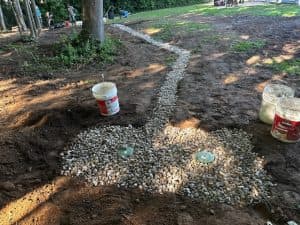
- Exterior French Drains: These are deep trenches filled with gravel and a perforated pipe. They are designed to manage groundwater. As the water table rises, it enters the pipe and is carried away before it can press against your foundation.
- Surface Drains (Catch Basins): These are the grates you see in low spots of a lawn. They are designed to manage surface runoff. If you have a “bowl” in your yard where water collects, a catch basin captures that water immediately and sends it into a solid pipe system.
Underground Downspout Diversion
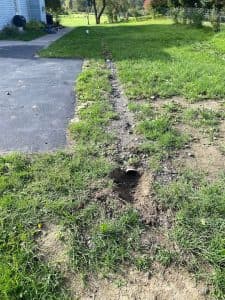
The most effective way to handle roof water is to “bury” the problem. We connect your downspouts to solid, high-density polyethylene (HDPE) pipes buried 12 to 18 inches underground. These pipes carry the water far away from the house—often to the curb or a lower point on the property—where it can be released safely through a pop-up emitter.
Why Proper Grading is Your First Line of Defense
Grading refers to the slope of the ground around your home. Ideally, the ground should “fall” at least 6 inches within the first 10 feet away from the foundation. Over the decades, homes in older neighborhoods (common in Pittsburgh and Rochester) often suffer from “settled grading.”
As the backfill soil settles, the slope reverses, and the ground begins to tilt toward the house. Regrading involves adding clean fill dirt and tamping it down to restore that positive slope. This is a simple mechanical fix that can reduce basement water infiltration by up to 50% without ever touching a pump.
The Highlander Approach: Surgical Installation
One reason homeowners hesitate to fix yard drainage is the fear of their landscaping being destroyed. At Highlander, we utilize a “surgical” approach. We carefully remove the sod, perform the necessary trenching and pipe installation, and then replace the turf so that, within a few weeks, you can barely tell we were there. We don’t just solve the water problem; we respect your property’s curb appeal.
Frequently Asked Questions
Q: Does a French drain go inside or outside?
A: Both systems exist. An interior French drain (under the basement floor) is best for managing water that has already reached the footer. An exterior French drain is designed to intercept water before it ever reaches the wall. Often, the best protection involves a combination of both.
Q: How do I know if I need a yard drain?
A: If you have “spongy” grass, moss growth in sunny areas, or standing water that lasts more than 24 hours after a rain, your natural drainage is failing. If you also see white powder (efflorescence) on your basement walls, the water is already trying to push through.
Q: Will a French drain ruin my landscaping?
A: While excavation is required, our team is trained in minimal-impact techniques. We map out the most efficient route to avoid major trees and garden beds, and we restore the grass to ensure your yard looks as good as it functions.
Basement waterproofing is a multi-layered strategy. While interior systems are vital for total security, ignoring yard drainage is like trying to bail out a boat without plugging the hole in the hull. By managing roof runoff, correcting the slope of your soil, and installing professional drainage systems like French drains and downspout diversions, you significantly reduce the workload on your sump pump and protect your foundation from the destructive power of hydrostatic pressure.
In the unique climate of Western PA and NY, where heavy rains and rapid thaws are the norm, your yard needs to be a partner in your home’s defense—not its enemy. At Highlander Waterproofing & Foundation Repair, we look at the big picture. We don’t just look at your basement walls; we look at the whole property to ensure your home stays dry, safe, and structurally sound for a lifetime.
Stop the Swamp in Your Backyard
Tired of soggy lawns and musty basements? Let the experts at Highlander design a custom yard drainage solution tailored to your property’s unique topography. Protect your foundation before the next big storm hits.
Call us today or visit our contact page to schedule your free yard drainage evaluation!

Giulio and Jennifer Bevilacqua are the dedicated and passionate owners of Highlander Waterproofing, a trusted name in basement waterproofing and foundation repair. With a commitment to protecting homes and ensuring the safety and well-being of families, Giulio and Jennifer have built Highlander Waterproofing into a premier service provider in the region. Their hands-on approach, combined with years of industry expertise, has helped them earn a stellar reputation for delivering reliable and effective waterproofing solutions.
The Bevilacquas pride themselves on offering personalized service, using proven techniques, and employing a team of highly trained professionals who share their dedication to quality workmanship. As a family-owned and operated business, Giulio and Jennifer emphasize integrity, transparency, and a genuine concern for their clients’ needs. They believe in building lasting relationships with their customers by ensuring each project is completed to the highest standards. Highlander Waterproofing continues to thrive under their leadership, offering innovative solutions and exceptional customer service that homeowners can depend on.