


Underneath your home lies a dynamic, moving geological force. Discover how regional clay soils cause foundation settlement and how underpinning stops the sinking cycle.
The Regional Geology: Understanding Expansive Clay Strata
When we look at a beautiful home, we admire the architecture, the framing, and the finish work. But from an engineering standpoint, a house is only as stable as the dirt beneath its concrete footings. Throughout Western Pennsylvania, Western New York, and Eastern Ohio, our regional geology presents a massive challenge for residential structures: dense, highly expansive clay soils.
Unlike sandy soils, which allow water to drain freely while remaining physically stable, clay is composed of microscopic mineral particles that absorb water like a sponge. This structural makeup makes our local soils highly volatile, shifting and moving with every major seasonal weather transition.
The Shrink-Swell Cycle: How Weather Conditions Move Your Home
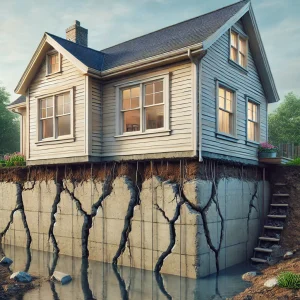
The core problem confronting your foundation is the continuous shrink-swell cycle of local clay. This process creates a destructive, repeating pattern of movement beneath your heavy concrete footings across the changing seasons.
Wet Seasons: Soil Expansion and Hydrostatic Uplift
During heavy spring rains or rapid lake-effect snow thaws, clay soils soak up immense volumes of water. As the clay particles expand, the total volume of the earth surrounding your home increases dramatically. This expansion exerts incredible upward and lateral physical forces against your foundation. The swelling ground can unevenly lift sections of your concrete footings or press hard against subterranean walls, causing early stress fractures.
Dry Seasons: Soil Contraction and Helical Structural Voiding
The real damage often occurs during dry summer stretches. As water evaporates from the earth, the clay shrinks and cracks, losing a significant portion of its volume. As the ground contracts, it pulls away from your foundation footings, leaving hollow pockets and empty voids directly beneath your heavy concrete load-bearing structures. Deprived of solid support, your home’s heavy concrete footings drop into these empty spaces under the weight of the house above.
Uniform House Settling vs. Destructive Differential Settlement
It is important to note that all houses settle slightly. If a home drops evenly across its entire footprint by a fraction of an inch, the movement is uniform, and you will rarely see any visible structural damage.
The real threat to your property is differential settlement. This occurs when one corner or side of your home sinks into a subsoil void while the rest of the foundation remains supported by stable ground. When one section drops independently, it introduces severe twisting and shearing stresses to your home’s skeletal framework. This differential movement breaks your foundation concrete and creates noticeable structural symptoms in your living spaces—such as jammed windows, sticking doors, and deep diagonal drywall cracks stretching from your door frames.
Underpinning Engineering: Driving Past Shifting Soils to Solid Bedrock
When a home is undergoing active differential settlement, superficial fixes like pouring more concrete over the cracks or filling gaps with foam are useless. The underlying soil remains unstable, meaning the house will continue to sink. Resolving the issue permanently requires an engineered process called structural underpinning.
- Resistance Steel Piers: For heavy multi-story homes or properties with deep structural masonry, resistance piers offer an ideal solution. Heavy-duty steel brackets are attached directly to your home’s foundation footings. Next, high-strength steel pier sections are driven deep into the ground using hydraulic equipment. The piers push straight through the weak, shifting topsoil until they strike solid bedrock or an ultra-dense, load-bearing soil layer that can safely bear the weight. Once anchored, your home’s weight is transferred off the shifting clay and onto the solid steel pier array.
- Helical Piering Systems: For lighter structures—such as porches, home additions, or lighter slab foundations—helical piers are preferred. These steel shafts feature large screw-like blades that allow them to be mechanically screwed deep into the earth until they reach stable, load-bearing soil layers. They provide a secure foundation anchor with minimal disruption to your yard.
FAQ: Understanding Soil Shifting and Settlement Fixes
Is it normal for a house to settle after 20 years?
Initial construction settling typically stops within the first few years. Sudden or continuous structural movement after decades usually points to changing drainage patterns, broken underground plumbing pipes, or severe regional drought cycles that are drying out deep subsoil clay layers.
What do foundation settlement cracks look like?
Settlement cracks usually present as stair-step patterns along the mortar joints of exterior brickwork or concrete blocks. Inside your home, they look like diagonal fractures stretching outward from the upper corners of door and window frames.
Can you stop a house from sinking without piers?
If deep subsoil layers are actively shifting or voiding, structural piers driven down to load-bearing bedrock are the only proven method to permanently stop the sinking cycle and safely stabilize the property structure.
Secure Your Home on Solid Ground
Don’t let shifting clay soils ruin your home’s safety, structural integrity, and long-term market value. At Highlander Waterproofing & Foundation Repair, we use precision diagnostic gear and laser levels to map out foundation movement accurately, without resorting to high-pressure sales lines or predatory tactics.
We focus on providing the exact engineering fix your home needs, backed by our Lifetime Transferable Warranty. Contact our local regional office today to request your free, comprehensive foundation settlement evaluation.

Giulio and Jennifer Bevilacqua are the dedicated and passionate owners of Highlander Waterproofing, a trusted name in basement waterproofing and foundation repair. With a commitment to protecting homes and ensuring the safety and well-being of families, Giulio and Jennifer have built Highlander Waterproofing into a premier service provider in the region. Their hands-on approach, combined with years of industry expertise, has helped them earn a stellar reputation for delivering reliable and effective waterproofing solutions.
The Bevilacquas pride themselves on offering personalized service, using proven techniques, and employing a team of highly trained professionals who share their dedication to quality workmanship. As a family-owned and operated business, Giulio and Jennifer emphasize integrity, transparency, and a genuine concern for their clients’ needs. They believe in building lasting relationships with their customers by ensuring each project is completed to the highest standards. Highlander Waterproofing continues to thrive under their leadership, offering innovative solutions and exceptional customer service that homeowners can depend on.