


A bowing basement wall is more than a cosmetic blemish—it is a critical indicator that environmental forces are pushing your home’s foundation to its absolute breaking point.
The Soil Physics Behind Bowing and Buckling Foundation Blocks

If you stand in your basement and notice that the middle of your block or poured concrete wall curves inward toward the room, you are witnessing structural deflection. This inward movement does not happen because your house is too heavy for its footings; rather, it occurs because the earth surrounding your home has turned into an aggressive horizontal battering ram.
Throughout Western Pennsylvania, Western New York, and Eastern Ohio, our regional geology is dominated by dense, highly expansive clay soils. Clay behaves quite differently from sand or gravel. When seasonal downpours or heavy winter snowmelts saturate the yard, clay soil expands dramatically, drinking in water and increasing in weight. This creates a relentless physical force known as hydrostatic pressure. Saturated soil can exert thousands of pounds of lateral pressure against your underground foundation walls—forces far greater than the original masonry was engineered to withstand.
Identifying Specific Wall Failure Mechanisms
Foundation walls do not fail randomly; they break down along predictable paths depending on how the lateral pressure is distributed. Recognizing these specific structural patterns is vital for designing an accurate engineering fix.
Horizontal Mid-Wall Fissures Along Mortar Joints
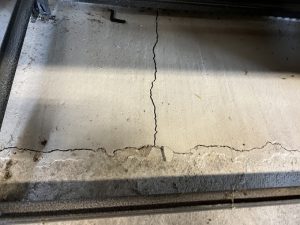
For concrete block foundations, the most common sign of failure is a long, continuous horizontal crack running through the mortar joint near the middle third of the wall. This happens because the top of the wall is held in place by the house floor joists, and the bottom is secured by the concrete slab. The middle of the wall becomes the weakest point, buckling inward under intense lateral soil pressure.
Bottom-Row Wall Shearing Above the Footing
In severe cases, the lateral pressure overcomes the connection between the very bottom row of foundation blocks and the concrete floor footing. When this occurs, the entire wall slides or “shears” inward over the slab. Shearing is a highly critical structural failure that requires immediate stabilization to prevent total wall displacement.
Inward Tipping at the Top Sill Plate Line
Sometimes the crack forms at the very top of the foundation wall. This happens when the exterior soil pressure pushes the top of the wall inward because it was not properly fastened or anchored to the wooden sill plate and floor joists of the upper living levels.
Engineered Stabilizers: Matching the Fix to Your Deflection Severity
An ethical foundation repair specialist will never recommend a one-size-fits-all solution. The correct repair method depends entirely on the exact measurement of inward deflection.
- Carbon Fiber Straps (Early-Stage Bowing): If your wall has bowed inward by less than 2 inches, aerospace-grade carbon fiber straps offer a non-invasive solution. These straps are bonded directly to the interior face of the wall with structural epoxy. Carbon fiber is virtually unstretchable, locking the wall in place permanently. It leaves a low profile that can easily be painted over or covered by drywall.
- Heavy-Duty Steel I-Beams (Severe Over-Deflection): When inward bowing exceeds 2 inches, structural steel I-beams are required. These beams are custom-fit to the height of your basement, anchored securely into the solid concrete floor footing at the bottom, and bracketed tightly to the heavy floor joists at the top. This counteracts the soil pressure and stabilizes the shifting masonry framework.
- Total Foundation Wall Rebuilds (The Last Resort): If a wall has bowed so severely that the blocks are severely cracked or structural integrity is completely lost, the only safe option is to excavate the exterior yard, support the home with structural jacks, tear down the failing masonry, and rebuild the wall from the footing up.
Why Cosmetic Patching (Hydraulic Cement) Is Dangerous for Structural Movement
When homeowners spot a horizontal crack, their first instinct is often to go to the hardware store, buy a tub of hydraulic cement, and plaster over the gap. While this might temporarily stop a water leak, it does absolutely nothing to halt structural movement. Hydraulic cement has no tensile strength. As the hydrostatic pressure continues to push against the wall during the next rainy season, the crack will simply reopen, and the wall will continue to bow further inward, making eventual repairs far more costly.
FAQ: Resolving Bowing Foundation Walls
Can a bowing basement wall collapse suddenly?
While foundation walls typically bow inward slowly over several seasonal cycles, a sudden spike in water pressure—such as a flash flood or a rapid spring thaw—can cause a severely weakened wall to fail or cave in unexpectedly.
Will carbon fiber straps pull my wall back to straight?
No. Carbon fiber straps are engineered to freeze the wall in its current position to stop further structural failure. If you want to push a wall back to straight, the exterior yard must be excavated to relieve the soil pressure, and heavy mechanical jacks must be used before securing the wall.
Does homeowner’s insurance cover bowing basement walls?
Standard homeowner insurance policies rarely cover foundation repairs caused by hydrostatic pressure, groundwater movement, or earth shifting, which makes proactive diagnostic inspections very important.
Permanently Stabilize Your Structural Framework
If you suspect your basement walls are beginning to bow, do not wait for the structural damage to worsen. At Highlander Waterproofing & Foundation Repair, we don’t believe in high-pressure sales lines or predatory tactics. Our experienced team uses precise diagnostic tools to evaluate your foundation and provide the minimal effective solution needed to protect your home permanently.
Every structural repair we perform is backed by our Lifetime Transferable Warranty. Contact our local regional office today to request your comprehensive, free property evaluation.

Giulio and Jennifer Bevilacqua are the dedicated and passionate owners of Highlander Waterproofing, a trusted name in basement waterproofing and foundation repair. With a commitment to protecting homes and ensuring the safety and well-being of families, Giulio and Jennifer have built Highlander Waterproofing into a premier service provider in the region. Their hands-on approach, combined with years of industry expertise, has helped them earn a stellar reputation for delivering reliable and effective waterproofing solutions.
The Bevilacquas pride themselves on offering personalized service, using proven techniques, and employing a team of highly trained professionals who share their dedication to quality workmanship. As a family-owned and operated business, Giulio and Jennifer emphasize integrity, transparency, and a genuine concern for their clients’ needs. They believe in building lasting relationships with their customers by ensuring each project is completed to the highest standards. Highlander Waterproofing continues to thrive under their leadership, offering innovative solutions and exceptional customer service that homeowners can depend on.
